
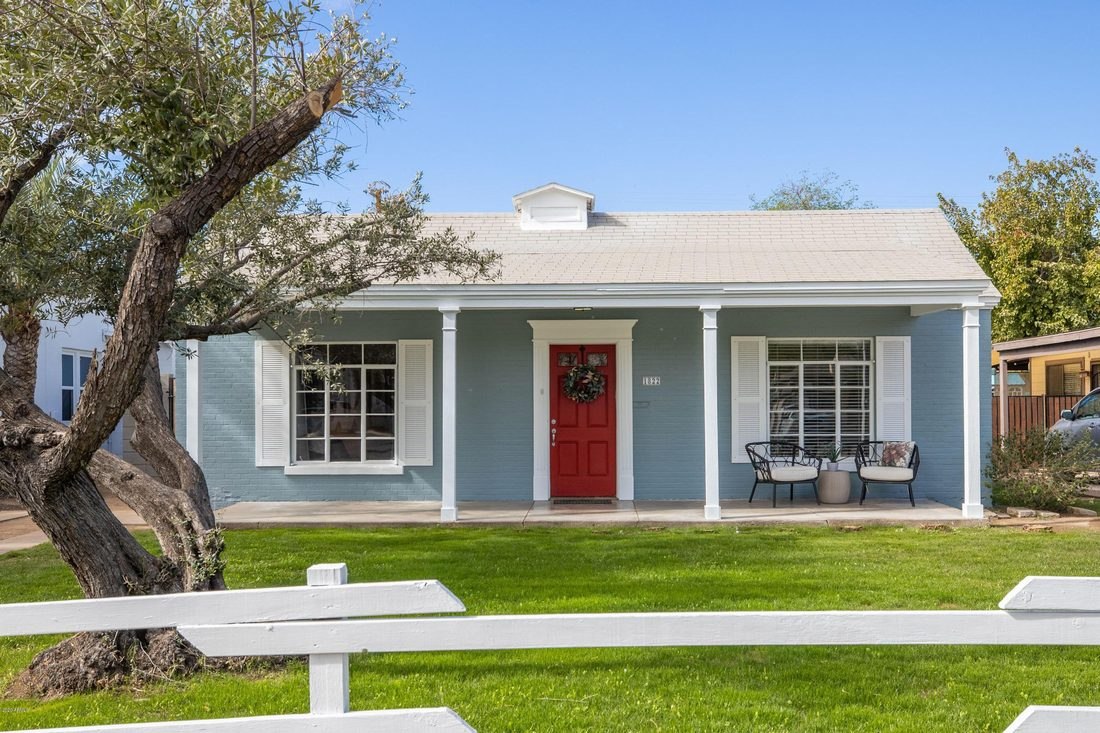
Most Phoenix neighborhoods are named for a founder or a street. Fairview Place was named for a view, and the view was the fair.
Laid out in the 1920s on the open land beside the state fairgrounds, Fairview Place is a pocket of 342 small, well-built historic homes. It is cozy, unpretentious, and quietly one of the most attainable historic districts in the city.
The storyOne of Phoenix's first real subdivisions
When Fairview Place was platted in the 1920s, it sat outside the Phoenix city limits, past the edge of town by the fairgrounds. It was one of the first attempts at a large-scale residential subdivision in Phoenix, marketed to a rising middle class. A 1928 newspaper advertisement promised that a home here would be a distinct social and business asset.
The houses went up over two decades. A few Period Revival homes came first in the late 1920s, then the bulk arrived through the 1930s and 1940s as the suburban idea took hold and FHA lending made modest homes affordable. By 1947, roughly 90 percent of the neighborhood was built. In all, 342 homes fill the district.
Neighbors formed an association in 1990 and, as an all-volunteer effort, measured, photographed, and researched every one of those 342 homes. In 1994 the work paid off. Fairview Place was granted historic designation and listed on the National Register of Historic Places, recognizing a period of significance from 1925 to 1949. The district runs from McDowell Road up to Encanto Boulevard, between 15th and 17th Avenues.
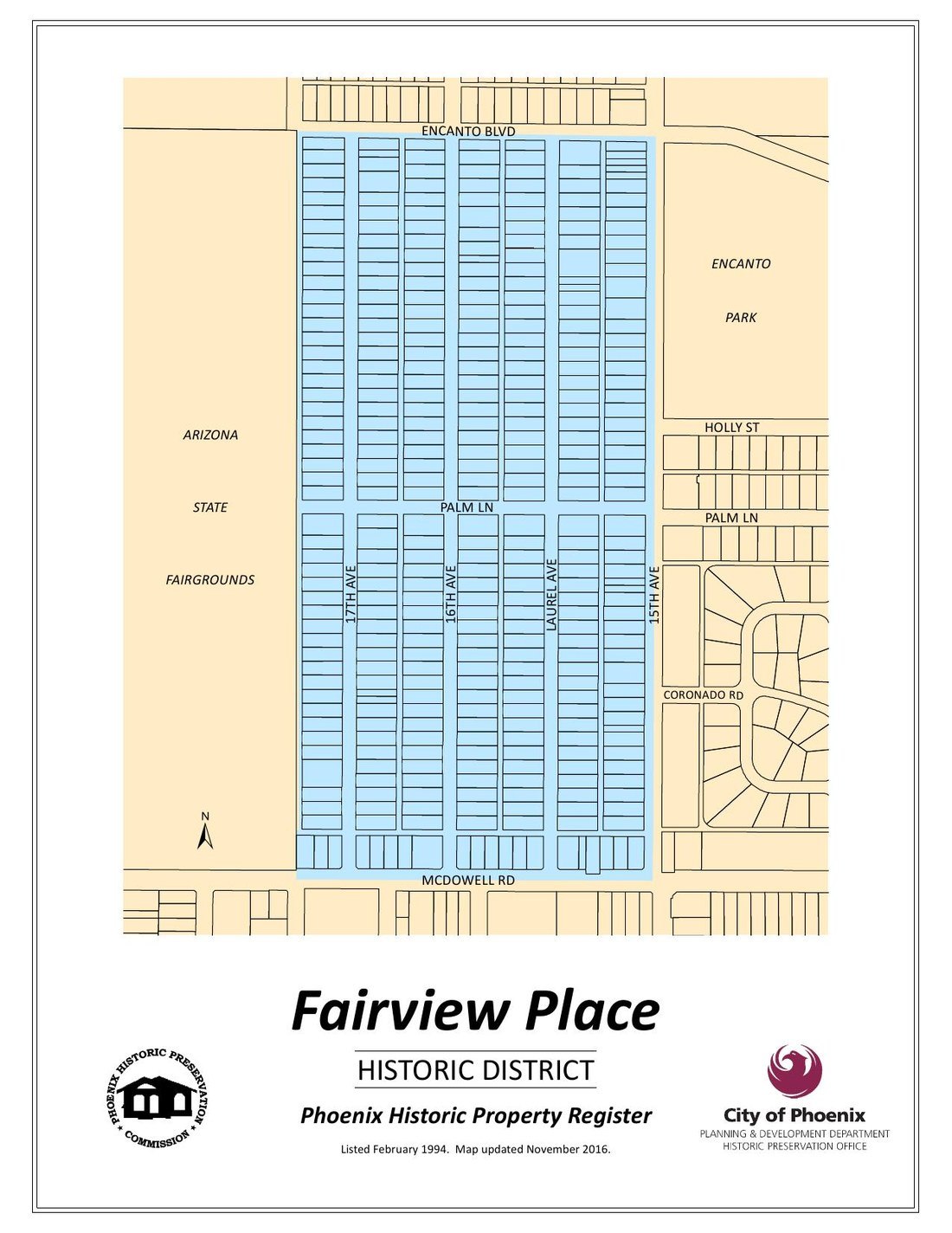
Named not for a founder or a street, but for a view. And the view was the fair.
Fairview Place, Central Phoenix
The fairgroundsThe fair that gave the neighborhood its name
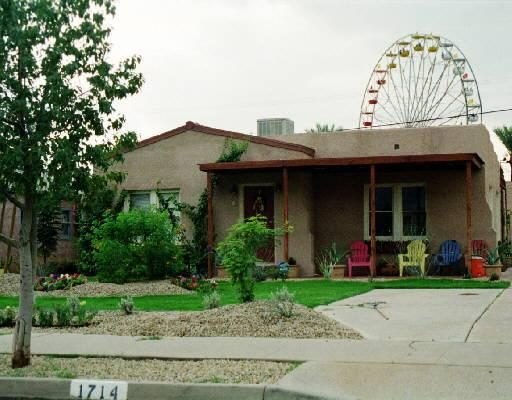
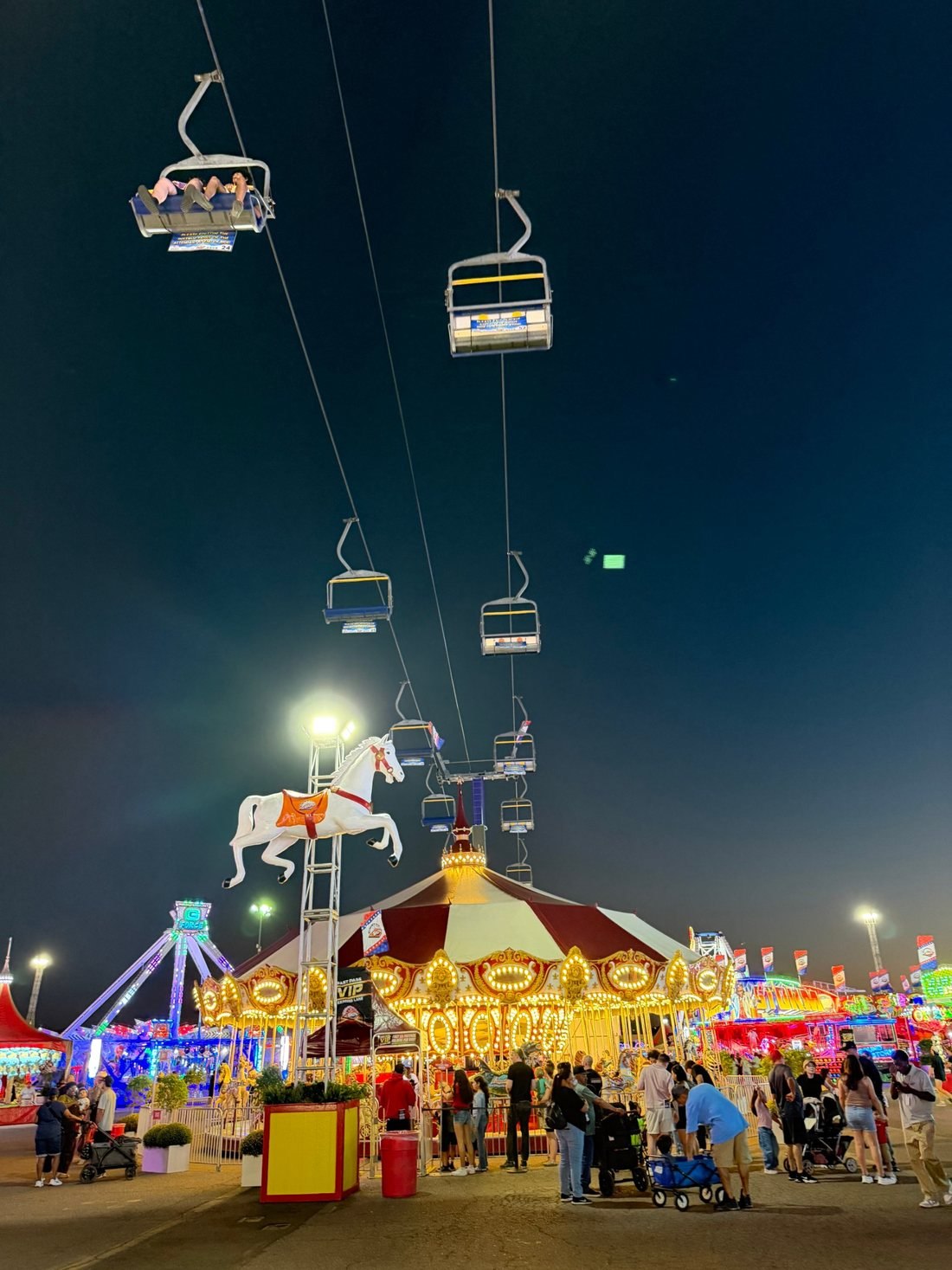
Just west of Fairview Place, at 19th Avenue and McDowell, sit the Arizona State Fairgrounds, and they are the reason this neighborhood took the shape it did. The fair came first, and the homes grew up looking out at it.
The fair itself goes back to 1884, when territorial Arizonans held the first Arizona Territorial Fair near the Salt River west of Central Avenue, with horse races, livestock, and agricultural exhibits. In 1891 the Salt River flooded and washed the original grounds away. The fair went dark until Phoenix Mayor John C. Adams raised private money to buy an 80-acre site north of town, at McDowell and 19th Avenue, and revived it in 1905 with a wooden grandstand and a one-mile racetrack.
That site became the fairgrounds we know. The grand bas-relief grandstand still standing there was built as a WPA project in 1936 and 1937, and the grounds have hosted horse racing, auto racing, and generations of rodeo, including the Native American Rodeo that draws competitors from tribal nations across the country. The Veterans Memorial Coliseum, the old Madhouse on McDowell, went up in the 1960s and once held the Phoenix Suns.
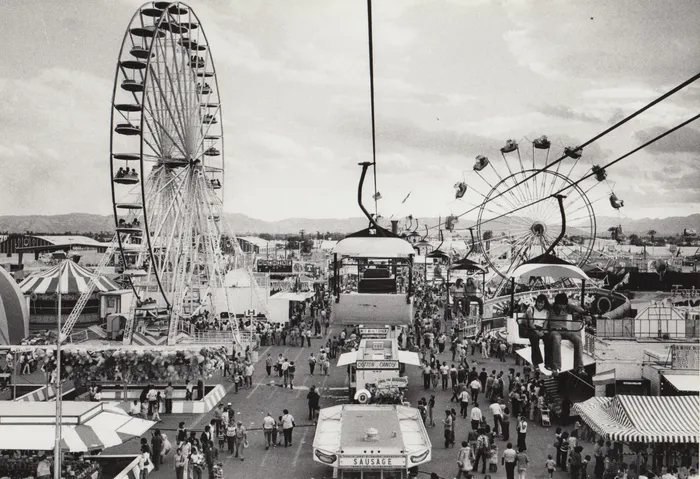
The Arizona State Fair is still one of the five largest in the country, drawing more than a million people every fall. This year it runs October 1 through November 2, a short walk from Fairview's front porches.
The homesFourteen styles, all on a human scale
Fairview Place is a sampler of early-20th-century design. Fourteen architectural styles sit side by side, from Tudor and English Stone Cottage to Southwest, Spanish Colonial Revival, French Provincial, and the Transitional Ranch homes that closed out the 1940s. What ties them together is scale. These are modest houses, mostly 900 to 1,400 square feet, built with real care rather than square footage.
They were the work of early Phoenix homebuilders. Andy Womack's building company put up many of the houses, and the district's nomination credits the architects and builders Maxwell and Anderson among others. By the late 1930s, FHA design standards were shaping the newer homes toward efficient, well-proportioned plans that still read as charming today.
- Tudor & English Stone CottageStorybook brick, steep rooflines.
- Spanish Colonial RevivalStucco, tile, arched detail.
- French ProvincialA touch of formal elegance.
- Transitional RanchThe long, low look of the 1940s.
The craftsmanship. Original woodwork, arched doorways, coved ceilings, and small custom touches you simply do not get in a new build. In Fairview, the charm is in the details.
The peopleWho called it home
Fairview Place was built for the people moving up in a growing city, young professionals and families who wanted a well-made home and a respectable address just outside the center. One of them went a long way. Wesley Bolin was living in Fairview Place when he was first elected Arizona Secretary of State. He went on to hold that office for decades and eventually became Governor of Arizona, and the plaza of state buildings beside the Capitol still carries his name today.
The valueThe historic district you can still get into
Here is the part buyers love. Fairview Place is one of the few historic districts in Phoenix where the door is still open. The homes are modest, so the prices are too. As of 2026, most trade from the low $400,000s into the $600,000s, with larger or fully remodeled homes reaching the $800,000s, and a district median in the high $500,000s. If you have been priced out of the marquee districts, this is where historic character is still within reach.
Prices move, so for what a specific home or block is doing right now, just ask me.
The lifeEncanto out the door, the city minutes away
Encanto Park sits right on Fairview's western edge, so the city's prettiest green space, the lagoons, the shade, the Rose Garden, and the Encanto Golf Course, is a block or two from your door. The course tavern serves breakfast and lunch, and Hamburger Works, a neighborhood institution, is just a few blocks away. Right across the street is the Encanto recreation area, with tennis, volleyball, basketball and sport courts, soccer and baseball fields, and the historic Encanto pool. On that same western edge stands the historic Valley Garden Center, once home to the oldest garden club in Phoenix and now a gathering and event space. Beyond that you are minutes from downtown, Roosevelt Row and its restaurants, and the Central Avenue museums. Close to the action, quiet when you get home.
Why it lastsProtected by the neighbors who love it
Fairview Place is a historic district today because its own neighbors fought for it, documenting all 342 homes by hand. That spirit is still alive. The Fairview Place Neighborhood Association charges no HOA fees, yet it is well organized and meets monthly, and it has earned several neighborhood block watch grants and exterior rehabilitation grants to revitalize the area. You get the cohesion and pride of a tended neighborhood without the dues or the rulebook.
That spirit is exactly what I work to protect. I serve as Secretary on the board of the Phoenix Historic Neighborhoods Coalition, a nonprofit that represents the people of Phoenix's 35 historic districts. The Coalition treats preservation as an economic engine, not a relic under glass. Protect the character, and the value follows.
See the districts for yourself
The Coalition created a self-guided Driving Tour Map that points you to all 35 historic neighborhoods and explains the architectural styles you will spot along the way. More than 85,000 free copies are out in the world, and it is one of the best ways to fall for historic Phoenix.
Your guideLet's find yours

Over 22 years in Arizona real estate, specializing in historic Phoenix and serving buyers and sellers valleywide, a decade in title and escrow before that, and a seat on the board that fights to keep these neighborhoods standing. I do not see houses as inventory. I see them as architectural art, and my job is helping you find the one that feels like you.
Thinking about Fairview Place?
Whether you are buying your first historic home, selling one with a story, or just curious what a place here is worth today, I would love to walk you through it.
Brokers Hub Realty · Downtown Phoenix
602-644-0852 · azrealestategotogirl.com
Fall in love with Home.